

In the remote landscapes of Australia, a rich tapestry of native botanicals thrives, carrying centuries of untold stories within their aromatic profiles. From the woody warmth of Australian Sandalwood to the green, floral richness of Brown Boronia, these ingredients are more than just scents - they are a connection to place, history, and the earth itself.
This guide explores the art of Australian native botanical perfumery, a craft that intertwines the continent's rare flora with the precision of French fragrance traditions. Through the lens of Goldfield & Banks, Australia's first luxury perfume house, we delve into the origins, ingredients, and techniques that define this unique olfactory tradition.
- Key Ingredients: Australian Sandalwood, Brown Boronia, Buddha Wood, Kunzea, and more.
- Fragrance Craftsmanship: How raw botanicals are transformed into refined perfumes.
- Choosing Your Scent: Tips for selecting fragrances that reflect Australia's diverse landscapes.
Each fragrance tells a story, rooted in the ecosystems that inspire it. Whether evoking the coastal scrublands of Tasmania or the tropical rainforests of Queensland, these perfumes are a sensory journey into the heart of Australia’s botanical treasures.
Goldfield & Banks Full Collection Review | Best vs Worst
Native Australian Ingredients and Their Scent Profiles
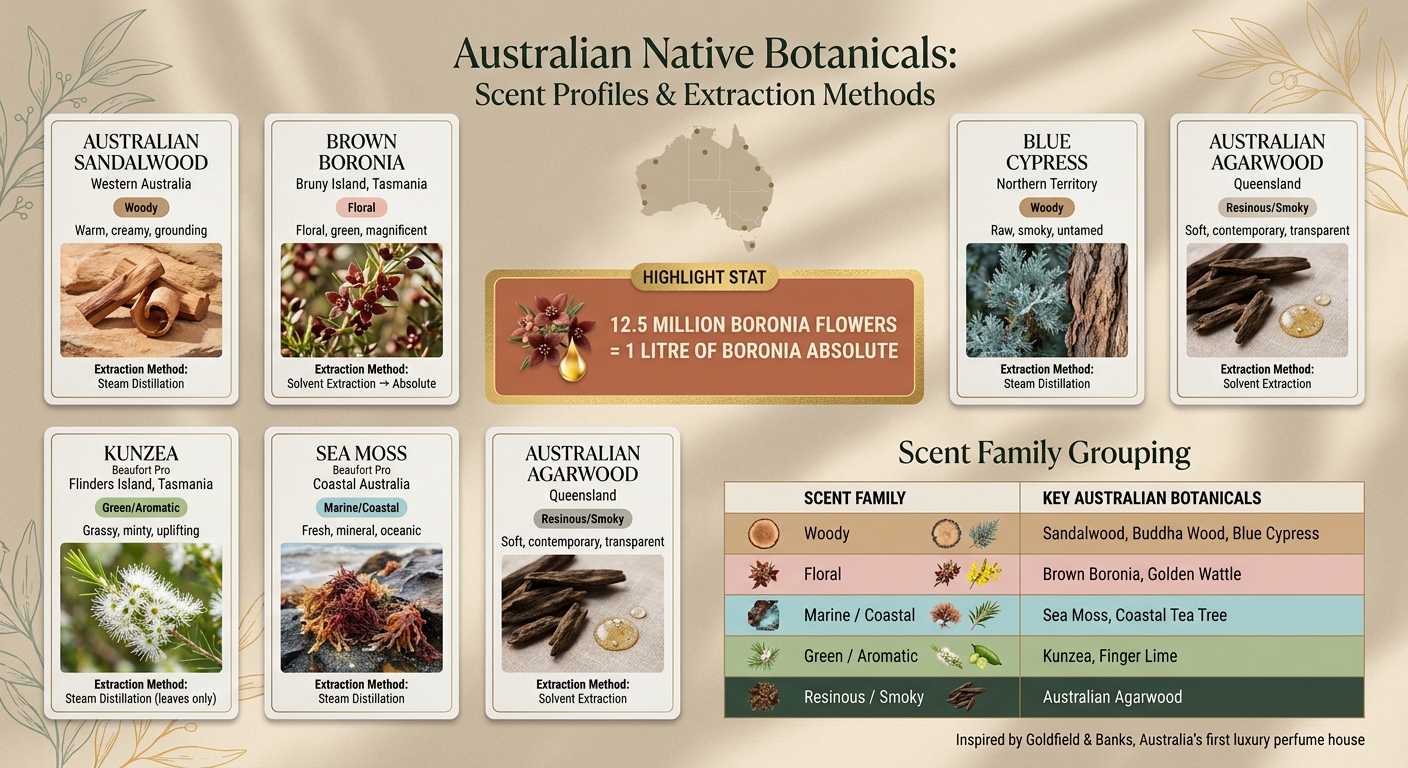
Australian Native Botanicals: Scent Profiles & Extraction Methods
Sandalwood, Boronia, and Wattleseed: Core Australian Botanicals
Australian Sandalwood, predominantly sourced from Western Australia, is a cornerstone of Australian perfumery. Its warm, creamy, and woody essence provides a grounding base note, offering depth without overshadowing other elements. This adaptability makes it an essential choice for creating fragrances that resonate with the Australian landscape.
Brown Boronia, cultivated on Bruny Island off Tasmania's coast, offers a scent profile unlike any other. Dimitri Weber describes its essence:
"Boronia flowers... the resulting liquid has a smell like nothing else on earth – floral, green, and magnificent."
The rarity of Boronia is underscored by the fact that 12.5 million flowers are required to produce just one liter of Boronia absolute. This scarcity ensures it is used with precision, adding an unparalleled richness to compositions.
Golden Wattle, also known as mimosa, contributes a soft, floral note that highlights the distinctiveness of Australia's olfactory tradition.
Blue Cypress and Sea Moss: Lesser-Known Australian Ingredients
Blue Cypress, derived from the timber of Callitris intratropica in the Northern Territory, delivers a woody aroma with raw, untamed nuances and a subtle smokiness. Its distinctive character evokes the rugged beauty of Australia's northern landscapes.
Sea Moss, featured prominently in the Pacific Rock Moss fragrance, brings a fresh, mineral quality that mirrors the coastal air and oceanic energy.
Kunzea, a shrub native to Flinders Island, offers a grassy, green scent with hints of mint. Known for its uplifting qualities, it bridges the gap between aromatic and therapeutic elements.
This wide array of ingredients showcases the depth and variety of Australia's botanical offerings, each with its own story and sensory appeal.
The Range of Scent Families in Australian Botanicals
Australia's botanical diversity is mirrored in its broad spectrum of scent families, reflecting the country's vast and varied ecosystems.
| Scent Family | Key Australian Botanicals |
|---|---|
| Woody | Sandalwood, Buddha Wood, Blue Cypress |
| Floral | Brown Boronia, Golden Wattle |
| Marine / Coastal | Sea Moss, Coastal Tea Tree |
| Green / Aromatic | Kunzea, Finger Lime |
| Resinous / Smoky | Australian Agarwood |
Among these, Australian Agarwood holds a special place. As Dimitri Weber notes:
"The agarwood we use... has a beautiful contemporary, soft feel that more classical agarwoods from Southeast Asia don't".
This modern interpretation of Agarwood brings a lighter, more transparent quality to fragrances, distinguishing it from its traditional counterparts and making it a prized ingredient in contemporary perfumery.
These native botanicals not only define the essence of Australian perfumery but also illustrate how raw ingredients are artfully transformed into luxurious fragrances.
How Raw Botanicals Become Perfume Ingredients
Extraction Methods: Distillation, Solvent Extraction, and Absolutes
The method used to extract a botanical’s essence plays a defining role in shaping its character. For Australian botanicals, this choice is guided by the plant’s structure and the delicate nature of its aromatic compounds.
Steam distillation is the go-to technique for sturdy materials like woods, leaves, and resins. Australian Sandalwood, Blue Cypress, Buddha Wood, and Kunzea are all distilled in this way. The process uses heat to turn the plant’s aromatic compounds into vapor, which is then condensed into essential oil. These materials are particularly suited to this method because their aromatic molecules withstand heat without losing their integrity.
Solvent extraction is reserved for more fragile botanicals that would not survive the heat of distillation. Brown Boronia is a prime example. Its scent is a complex blend of floral, green, and fruity notes, which would be destroyed by steam. Instead, solvents are used to draw out its aromatic compounds, creating a concrete. This is further refined with alcohol to produce the final absolute:
"A vast number of these delicate flowers is required to yield even a small quantity of Boronia absolute... and the resulting liquid has a smell like nothing else on earth: floral, green, and magnificent."
Kunzea offers a unique case within distillation. While its blossoms are visually appealing, they carry no scent. As Weber explains, "The flower [of Kunzea] is cute, but we don't use the flower, it doesn't smell. But the leaves... they are the ones that smell. It looks like grass. It smells a bit grassy too, very green." Identifying the right part of the plant to harvest is as vital as the extraction method itself.
These techniques underscore the complexity of working with rare and delicate native botanicals.
Working with Rare Native Materials: Challenges and Solutions
The transformation of raw botanicals into refined perfume ingredients involves overcoming significant challenges, particularly when working with rare native materials.
Raw extracts often require further refinement before they are suitable for luxury perfumery. As Weber notes, "Raw ingredients alone do not create a refined fragrance; it is the expert blend and formulation that defines uniqueness." Australian natives present additional hurdles due to their geographic isolation and limited history in the global fragrance market.
Take Kunzea, for instance. It is harvested on Flinders Island, a remote location off Tasmania’s northeastern coast with a population of about 500. In 2024, Weber collaborated directly with a local farmer to oversee the harvest of Kunzea leaves and their distillation into oil for Mystic Bliss. The raw oil was then sent to Firmenich in Paris, where perfumer Florian Gallo transformed its grassy, therapeutic qualities into a polished, powdery chypre composition. This journey - from a remote island to a Parisian laboratory - reflects the intricate balance of local sourcing and global expertise that defines this craft.
Goldfield & Banks maintains rigorous oversight throughout the process, ensuring both quality and sustainability. This includes innovative measures like using organic beetroot alcohol to create a cleaner aromatic profile. Such attention to detail is especially critical for materials like Queensland Agarwood, where sustainable sourcing requires specialized partnerships and substantial investment.
sbb-itb-a2a0d05
Building Fragrances with Australian Botanicals
Creating Accords with Native Materials
Goldfield & Banks draws deeply from the character of Australia's botanicals, crafting fragrances that highlight the unique essence of each ingredient. The process often begins with a single native material - a standout botanical chosen for its distinct profile and the story it tells. From there, the perfumer carefully layers complementary notes to enhance or balance the hero ingredient. As Dimitri Weber explains, "Raw ingredients are not nice. It's always the blend, the creation, the formula that makes it unique."
Take Boronia absolute as an example. In its concentrated state, this extract is intense and unrefined, requiring skillful handling to reveal its softer, warmer dimensions. Similarly, working with Queensland-grown Agarwood demands precision due to its high value. Each decision in blending these premium materials is deliberate, aiming to create accords that bring out the finest qualities of these botanicals. This foundation is then elevated using the artistry of French perfumery, where traditional techniques refine and transform these raw materials into luxurious fragrances.
How French Perfumery Techniques Shape Australian Fragrances
Goldfield & Banks has pioneered the fusion of native Australian botanicals with the expertise of French perfumery. By collaborating with master perfumers in Paris, raw Australian extracts are evaluated and integrated into sophisticated olfactory compositions. This approach bridges two worlds - Australia’s natural abundance and France’s perfumery heritage.
The creation of Mystic Bliss exemplifies this collaboration. Over several years, Dimitri Weber partnered with perfumer Florian Gallo of Firmenich in Paris to incorporate Kunzea leaf oil into a powdery chypre framework. "I really wanted the perfume to be perfect... I like to refine perfumes, like push the boundaries of the perfumers", Weber shared. The result is a fragrance that retains the fresh, grassy essence of Kunzea while achieving a smooth, enveloping finish.
"The vision was clear: to honour this land through a gender-free collection that pairs native Australian botanicals with French perfumery savoir-faire." - Goldfield & Banks
Goldfield & Banks further distinguishes itself with formulations containing over 20% perfume essence, diluted in organic beetroot alcohol instead of synthetic bases. This choice not only enhances the aromatic purity but also reflects a commitment to creating cleaner, more refined fragrances. These meticulous methods also influence how the perfumes perform on the skin, ensuring a luxurious experience.
Diffusion, Longevity, and Texture in Native Ingredient Perfumes
The careful selection and blending of Australian botanicals result in fragrances that perform as beautifully as they smell. These native ingredients contribute not just to the scent but to the way a perfume interacts with the skin. For instance, Blue Cypress and Buddha Wood are prized for their aromatic depth and the texture they bring to compositions. Woody materials from Australia often act as anchors, slowing the fragrance's diffusion and extending its presence during the dry-down phase.
Goldfield & Banks rigorously tests its fragrances in humid conditions to ensure they meet the highest standards of performance. This dedication results in what the house calls an "Australian sillage" - a scent trail that reflects the richness of the country’s botanicals, even within complex, layered creations.
How to Choose an Australian Native Botanical Perfume
Reading Ingredient Lists and Scent Profiles
When exploring Goldfield & Banks fragrances, it’s helpful to first identify whether the scent belongs to the Native Collection or the Botanical Series. The distinction lies in focus: the Native Collection celebrates a singular Australian botanical such as Boronia, Golden Wattle, or Blue Cypress, while the Botanical Series highlights global botanicals like Lavender or Agarwood that have been cultivated in Australian soil, giving them a distinctly local character.
Understanding how a fragrance unfolds over time is equally important. Goldfield & Banks describes this as a three-stage journey: the "Sunrise" introduces fresh top notes, the "Summit" reveals the heart of the fragrance, and the "Sunset" leaves a lasting impression with base notes. This progression offers insight into how the scent evolves throughout the day, helping you anticipate its full expression.
Concentration also plays a crucial role. Goldfield & Banks ensures a minimum of 20% scented essences in its perfumes, allowing the woody, resinous, and floral notes of Australian botanicals to fully develop and linger. Lower concentrations can mute the complexity of rare notes like Kunzea or Boronia, compressing their evolution.
Armed with this knowledge, you can choose a fragrance that not only tells a story but also mirrors the essence of Australia’s landscapes.
Choosing Fragrances That Connect to Place
Once you’ve decoded the ingredient list, the next step is to consider how a fragrance reflects its place of origin. Goldfield & Banks draws inspiration from Australia’s diverse environments, offering scents that resonate with specific landscapes. For example, Pacific Rock Moss channels the essence of coastal rock formations and salty sea air, while Mystic Bliss, launched in August 2024, takes cues from the Aurora Australis and the Kunzea shrub found on Flinders Island near Tasmania. Its green, grassy, and minty profile is described as both comforting and invigorating. For those captivated by the rugged beauty of the outback, fragrances like Buddha Wood and native Sandalwood from Western Australia evoke the warmth of the red-earth interior.
"I want every Goldfield & Banks perfume to transport its wearers to the places in Australia that inspired it" - Dimitri Weber, Founder, Goldfield & Banks
Think about which landscape you’d like to carry with you - coastal brightness, desert stillness, rainforest vibrancy, or alpine coolness. Each environment brings its own botanical identity, offering a deeply personal connection through scent.
Using Discovery Sets and Layering to Find Your Fragrance
Given the rarity of botanicals like Kunzea, Buddha Wood, and Blue Cypress in mainstream perfumery, sampling before committing to a full bottle is a wise approach. Goldfield & Banks offers Discovery Sets, allowing you to experience how these fragrances interact with your skin over time, revealing layers that a quick test on a strip might miss.
Discovery sets also open the door to layering, a technique that lets you create a personalized scent. For instance, combining the creamy base of White Sandalwood with a lighter, greener fragrance can result in a unique aroma that reflects your preferences. With the collection designed to be gender-free and inspired by complementary Australian landscapes, many scents naturally harmonize with one another, offering endless possibilities for customization.
Conclusion: The Essence of Australian Perfumery
Australian native botanical perfumery brings together the country's remote landscapes, lesser-known botanicals, and an unwavering dedication to craftsmanship. Ingredients such as Brown Boronia, Blue Cypress, Buddha Wood, and Kunzea go beyond being rare finds - they embody an olfactory identity that is distinctly Australian and unlike anything else in the world.
What sets this category apart is its meticulous attention to detail. From the traceability of ingredients from field to extraction, to IFRA-compliant formulations that utilize organic beetroot alcohol, every step reflects the precision and purity of Australia's landscapes. As Goldfield & Banks eloquently puts it: "Luxury is defined not as extravagance, but the use of the finest essences available without compromising the earth."
Since its inception in 2016, Goldfield & Banks has established itself as a leader in this space, achieving milestones such as Southern Bloom's silver award at the 2019 Pure Beauty Awards. This recognition signaled the arrival of Australian botanical perfumery on the global stage.
"Australia held extraordinary essences that modern fine fragrance had barely touched." - Dimitri Weber, Founder and Creative Director, Goldfield & Banks
FAQs
What makes Australian native botanical perfumes different?
Australian native botanical perfumes stand apart for their incorporation of rare ingredients influenced by the continent's varied geography and ancient, nutrient-rich soils. These unique elements give rise to aromatic profiles that are layered and distinctive. Goldfield & Banks elevates these raw materials by combining them with refined French perfumery techniques. Through methods such as steam distillation and CO₂ extraction, the natural intricacy of these botanicals is carefully preserved, capturing the spirit of Australia's diverse landscapes - from its arid deserts to lush rainforests.
Why is Boronia absolute so expensive?
Boronia Absolute commands a high price, driven by its exceptional rarity and the painstaking process required to produce it. To create just one liter of this precious essence, an astounding 12.5 million flowers are needed. Each bloom must be carefully hand-harvested, often under demanding conditions, highlighting the extraordinary effort and limited availability that elevate this botanical extract to such a coveted status.
How can I test and layer Goldfield & Banks Australia scents at home?
Goldfield & Banks discovery sets offer an excellent way to experience a range of fragrance profiles before selecting a full bottle. These thoughtfully crafted scents are designed to complement one another effortlessly. For layering, start by applying one fragrance as a base, then add another on top, experimenting to create a scent that feels uniquely yours. Each eau de parfum is crafted with premium, traceable botanicals, ensuring combinations that blend beautifully and reflect your personal style.