

Along the Southern Coastline of New South Wales and through Tropical Queensland, Native Australian Botanicals give luxury scent something buyers now look for with care: a named place, a clear scent identity, and a story rooted in land rather than image alone. In high-end fragrance, origin now helps shape how a perfume is judged, remembered, and chosen. That shift matters because a scent tied to Boronia from Bruny Island, Blue Cypress from Kakadu, or Agarwood from Tropical Queensland feels more legible on skin and in memory.
A few points stand out:
- Provenance helps shape value
- Australian flora offers place-led scent profiles
- Named landscapes make fragrance easier to recall and describe
- Both new niche buyers and collectors respond to origin in different ways
From the Atherton Tablelands to the east coast headlands, this is where place begins to define perfume more clearly.
Australian native botanicals are often supplied as Essential Oils, Absolutes, and CO2 extracts, drawn from a flora base of more than 18,000 native plant species. That scale gives perfumers a broad palette, but the deeper appeal sits elsewhere. These materials carry the conditions that formed them: salt air, dry heat, rainforest humidity, bushland resin, and mineral coast. On skin, that can read as citrus-toned, green, woody, herbal, or resinous, depending on the plant and the region behind it.
What matters to buyers is not origin as a label alone. It is origin as part of the perfume’s character. Place becomes part of the scent itself.
Across buyer behavior, a few patterns are clear. First-time niche fragrance customers often respond to scents that feel easy to place and easy to describe. A perfume built around Finger Lime from Byron Bay or Coastal Moss from South Coast NSW gives them that entry point. Collectors tend to look more closely at rarity, material detail, and extraction, which is why Boronia Absolute, Blue Cypress, Wattleseed, and Australian Agarwood carry weight.
The core demand can be reduced to five drivers:
- Place: a clear Australian origin gives the perfume shape
- Story: a named botanical or region helps it stay in memory
- Scent character: the profile feels regional rather than vague
- Self-expression: wearers use scent to signal taste and point of view
- Reaction: perfumes tied to a clear landscape often prompt attention and conversation
This helps explain why native botanicals now hold a stronger position in luxury scent. Buyers are not only choosing notes. They are choosing where those notes come from, and what that says about the perfume as a whole.
Australian scent identity is often read through landscape. The ocean air of the South Coast, the dense green humidity of the Daintree, the dry woods of inland ranges, and the still heat of the outback desert plains each shape a different mood. That is why a perfume linked to Bruny Island, Byron Bay, or Tropical Queensland arrives with more than aroma. It arrives with a setting the wearer can picture.
That sense of place also changes how fragrance is discussed. A scent anchored in a named region becomes easier to recommend, easier to remember, and easier to describe. Instead of speaking in broad terms about refinement, the language becomes more exact: Coastal Moss, Boronia, Kunzea, Agarwood. The result is a perfume identity tied to land, climate, and botanical source.
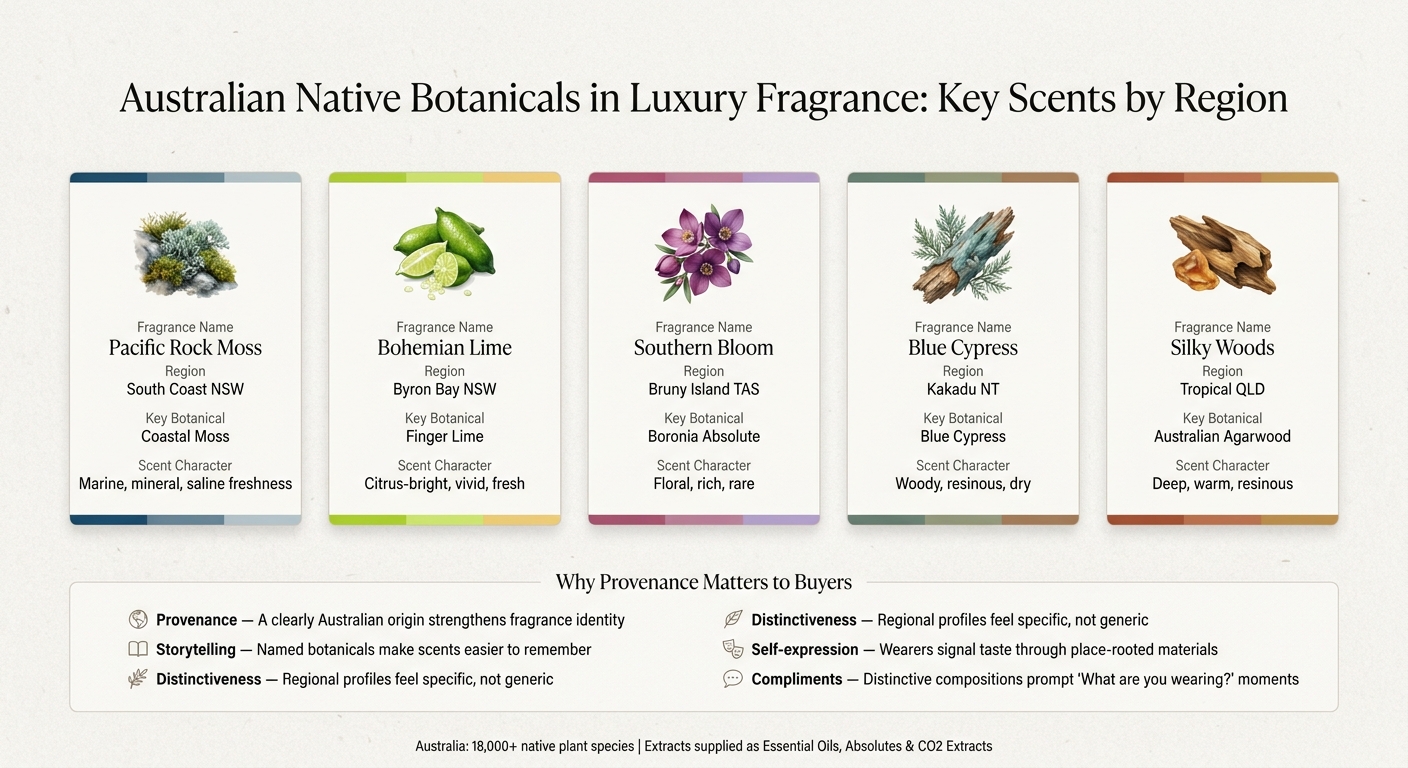
Goldfield & Banks offers a clear case of how this approach works in practice. Founded in Sydney in 2016, the house places Australian botanicals at the center of its fragrance design. In the Native Collection, places such as the South Coast of New South Wales, Byron Bay, Bruny Island, and Kakadu are translated into scent through materials like Coastal Moss, Finger Lime, Boronia Absolute, and Blue Cypress. In the Botanical Series, the focus moves toward rarer materials and higher concentration, including Agarwood Australia from Tropical Queensland.
A few examples show how closely scent and place are joined:
- Pacific Rock Moss - South Coast NSW, shaped by Coastal Moss and marine mineral notes
- Bohemian Lime - Byron Bay NSW, centered on Finger Lime
- Southern Bloom - Bruny Island TAS, built around Boronia Absolute
- Blue Cypress - Kakadu NT, grounded in Blue Cypress
- Silky Woods - Tropical QLD, led by Australian Agarwood
Customer response often returns to that bond between botanical and landscape. When a fragrance is tied to a specific region and material, it tends to leave a sharper imprint. The much-discussed compliment effect follows naturally from that clarity: people notice what feels unusual in the best sense of the word, and they ask about it.
The larger direction is plain. Luxury fragrance buyers want perfumes with a traceable origin, a stronger sense of identity, and stories grounded in real landscapes. Native Australian Botanicals meet that demand with precision. From Coastal Moss on the South Coast to Boronia on Bruny Island and Agarwood in Tropical Queensland, place is no longer secondary. It is part of the perfume from the opening note onward.
Used with care, these botanicals give luxury scent a closer link to land, memory, and wearer's identity.
What Native Botanicals Are and Where Australia Fits In
Across Australia, from the humid canopies of Tropical Queensland to the salt-washed headlands of the Southern Coastline, native botanicals carry the scent of place with unusual clarity. These aromatic materials come from plants native to a given region and are most often supplied as Essential Oils, Absolutes, or CO2 extracts. In Australia, that category is strikingly broad, with more than 18,000 native plant species feeding contemporary perfumery.
Australia holds a distinct place in fragrance because its biodiversity yields a broad aromatic palette. That range includes ingredients such as Eucalyptus, Lemon Myrtle, Tea Tree, Kunzea, and Paperbark-derived oils. Yet botanical variety is only one part of the story. The deeper point lies in how Australian flora wears on skin, where brightness, texture, and place tend to unfold with unusual clarity.
Why Australian Flora Has a Distinct Scent Character
From the Atherton Tablelands, where dense green growth holds heat and moisture, to coastal regions shaped by wind, salt, and sun, Australian flora often carries a scent character that feels fresh, vivid, and highly aromatic. Lemon Myrtle, Tea Tree, Rosalina, and Kunzea all sit within that profile, each bringing its own tone and texture.
Regional ecology shapes the result. A material may lean citrus, resinous, herbal, or green depending on where it grows and the conditions that form it. That regional signature gives these botanicals their clear presence in fine fragrance. Paired with careful extraction, native materials move beyond novelty and become part of a fragrance’s identity.
Native Ingredients as a Marker of Luxury
In fine fragrance, buyers respond to more than aroma alone. Native ingredients signal value through provenance, scent character, and the care taken in extraction. For Australian botanicals, origin is not separate from the scent. It is part of the scent itself.
What Research Shows About Consumer Preference
From the Southern Coastline to the outback desert plains, Australian botanicals tend to resonate most when their place of origin, scent profile, and story are immediately legible. Buyers read that kind of clarity as credibility.
That pattern can be seen in the way customers speak about fragrances shaped by Australian ingredients.
Provenance, Ethics, and Self-Expression
At Goldfield & Banks Australia, provenance, French technique, and sustainable extraction are presented as a single idea. Customers often describe these fragrances as more than scent alone, which suggests that origin, composition, and storytelling work together as a form of self-expression.
That response shifts depending on how familiar the buyer is with niche fragrance.
Why Australian-Origin Ingredients Appeal to Different Buyer Groups
For first-time niche buyers, clarity often matters most. Native materials offer an immediate sense of place and an easy entry into scent that feels distinctive without becoming obscure. For more experienced collectors, depth and precision tend to matter more. That is where materials such as Blue Cypress from Kakadu, Coastal Moss from South Coast NSW, Wattleseed, and ingredients tied to the Daintree rainforest become especially persuasive. This balance of recognizability and detail allows native botanicals to speak to different levels of fragrance fluency.
Key Drivers Behind Native Botanical Demand
- Provenance: A clearly Australian origin gives a fragrance a stronger identity.
- Storytelling: Botanical narratives make a scent easier to remember and describe.
- Distinctiveness: Native materials offer scent profiles that feel specific rather than generic.
- Self-expression: Wearers can signal taste through materials rooted in place.
- Compliments: Distinctive native compositions often prompt “What are you wearing?” responses.
These preferences make provenance more than a label; they shape how the fragrance is understood.
Why Provenance and Place-Based Storytelling Matter
From the Southern Coastline to the Atherton Tablelands, an ingredient from a named place carries more than aroma alone. It brings its climate, soil, light, and the associations that gather around that landscape. In native Australian perfumery, provenance turns a material into a marker of place, which is why buyers respond so strongly to specificity. That sense of origin shapes the way Australian scent is described and remembered.
The Shape of an Australian Scent Identity
Australian perfumery is often read as open, fresh, and textural, with dry woods and saline freshness. Yet those qualities do not come from abstraction. They are shaped by distinct regions: the ocean air of the coast, the resinous depth of bushland, the sun-struck stillness of the desert, and the dense green humidity of the rainforest. Each landscape creates a different sensory register, so the materials feel recognizably regional rather than generically aromatic. That clarity is what niche fragrance audiences respond to.
How Niche Fragrance Discourse Talks About Native Scents
In niche fragrance reviews and discussion, native Australian scents are often framed through travel, memory, and landscape. A fragrance linked to Byron Bay, Bruny Island, or Tropical Queensland arrives with a setting the wearer can picture. Provenance shapes how the scent is read, remembered, and recommended. That same clarity of place is what makes Australian-origin houses especially memorable in customer feedback.
Native Australian Botanicals vs. Standard Luxury Ingredients
The distinction is legibility, not quality alone. Native Australian botanicals such as Boronia, Blue Cypress, Coastal Moss, or Australian Agarwood give a fragrance a clear place signature. The composition becomes easier to picture, easier to describe, and easier to discuss because it is anchored in a landscape rather than a vague idea of refinement.
sbb-itb-a2a0d05
Case Insight: Goldfield & Banks and Native Botanical Luxury
Australian Native Botanicals in Luxury Fragrance: Key Scents by Region
An Australian House Built Around Botanical Provenance
From the Southern Coastline to the outback desert plains, Goldfield & Banks shows how place-led perfumery takes shape with clarity and purpose.
Founded in Sydney in 2016 by Dimitri Weber, the house brings French perfumery technique into close dialogue with Australian native botanicals. Its two collections reflect that focus in different ways. The Native Collection translates coast, desert, and forest into scent, grounding each composition in a distinct Australian setting. The Botanical Series sits at a higher tier, shaped by rare ingredients, careful extraction, and the spirit of botanist Joseph Banks’ 1770 voyage. Across both collections, native botanicals remain at the center.
That approach makes provenance part of the brief from the very beginning. Place is not added afterward as atmosphere or story. It is built into the fragrance concept itself, whether the inspiration comes from Coastal Moss along South Coast NSW, Boronia from Bruny Island, or Agarwood from Tropical Queensland.
What Customer Behavior Reveals
Customer response shows how that positioning carries beyond the page and into daily wear.
Feedback returns again and again to the Australian origin story, suggesting that the link between scent and place is not just understood but remembered. The brand also points to a recurring "compliment effect" - people being stopped and asked what fragrance they are wearing - and that pattern helps explain the appeal for both seasoned collectors and first-time niche buyers. When a fragrance is tied so clearly to a landscape, a botanical, and a point of origin, it tends to leave a sharper impression.
Conclusion: Native Botanicals as a Lasting Direction in Luxury Scent
Across Australia’s coastlines, rainforests, desert plains, and island landscapes, Native Botanicals continue to shape a clear direction in luxury scent. This pattern points to a larger shift: these materials answer luxury buyers’ demand for originality, a clear sense of place, and fragrance stories that feel grounded rather than interchangeable. Australian flora speaks to different buyers in different ways. Collectors are drawn to rarer scent profiles, while newer niche buyers look for a fragrance with an origin they can trace and understand.
Goldfield & Banks shows that provenance carries the most weight when it is built into the fragrance from the very beginning. When a scent starts with place, whether that is Coastal Moss from the South Coast of New South Wales, Boronia from Bruny Island, or Agarwood from Tropical Queensland, origin becomes part of the fragrance’s character rather than an afterthought. The case shows how place-led perfumery turns origin into value.
Used with care, Native Australian Botanicals bring together originality, place, and identity.
FAQs
What makes provenance matter in luxury fragrance?
Provenance matters because it gives a fragrance a clear origin story. When a scent is tied to a place such as the Southern Coastline of New South Wales, the Atherton Tablelands in Queensland, or the red earth of the outback desert plains, its character becomes easier to understand. The landscape explains why certain ingredients feel so distinct, whether that comes from Australian Coastal Moss shaped by ocean air, Boronia from Bruny Island’s brief flowering season, or Agarwood from Tropical Queensland with its deep, resinous warmth.
In fine fragrance, that sense of place shapes how a customer reads, describes, and connects with a perfume. A scent no longer sits as a blend of notes alone. It carries the salt of east coast headlands, the softness of sunlit dunes, or the dense canopy of Tropical Queensland, and that gives it language, memory, and presence.
Provenance also strengthens product storytelling, especially when native botanicals and Australian-origin ingredients speak to both seasoned collectors and those discovering niche perfume for the first time. For collectors, origin adds depth and precision. For new buyers, it offers a clear way into the fragrance, grounded in place, ingredient, and mood rather than abstraction.
How do native Australian botanicals change a perfume’s scent profile?
Native Australian Botanicals give a perfume its sense of place. They bring the scent closer to the land itself, whether that is the Southern Coastline of New South Wales, the sunlit dunes of the east coast, or the red earth of the outback. In fine fragrance, these botanicals shape compositions that feel unmistakably Australian, with a character that speaks to both seasoned collectors and those discovering niche perfumery for the first time.
They also shape the way a fragrance is described and understood. Origin matters. Ingredient identity matters. Story matters. A note like Coastal Moss from South Coast NSW or Boronia Absolute from Bruny Island carries more than aroma alone; it brings provenance, mood, and a clearer picture of the landscape behind the perfume.
Which native botanicals appeal most to new buyers versus collectors?
New buyers are often drawn to Native Botanicals that feel immediate and easy to understand through the story around the fragrance. A note such as Coastal Moss from South Coast NSW or Finger Lime from Byron Bay gives the scent a clear setting from the outset, rooted in ocean air, sunlit headlands, or citrus groves warmed by the coast.
Collectors, by contrast, often look more closely at provenance, rarity, and the kind of fragrance conversation that surrounds a material over time. Ingredients with a defined origin, such as Agarwood from Tropical Queensland or Boronia Absolute from Bruny Island, Tasmania, carry that depth. They speak not only through scent, but through place, harvest, and perfumery craft.
In this context, Australian-origin Botanicals appeal to both groups because they offer a distinct sense of place and a clear point of difference within luxury fragrance.