

Australia's native botanicals are reshaping luxury perfumery with bold, earthy, and aromatic scents that stand apart from traditional French florals. These ingredients, sourced from diverse landscapes like deserts and rainforests, are prized for their rarity and depth. Brands like Goldfield & Banks are leading the charge, blending these unique oils with French techniques to create high-end fragrances. Here's a quick look at seven standout botanicals:
- Australian Sandalwood: Woody, creamy, and spicy; used in heart and base notes.
- Boronia: Floral with hints of tea and moss; adds complexity to heart notes.
- Wattleseed: Nutty and roasted; a warm, grounding base note.
- Lemon Myrtle: Vibrant citrus; energizes top notes.
- Desert Rosewood: Smoky and resinous; anchors base notes.
- Blue Cypress: Cool, woody, and herbal; bridges heart and base notes.
- Tasmanian Lavender: Herbaceous with violet and spice; a bold top note.
These botanicals not only deliver rich, layered scents but also reflect Australia’s natural beauty and commitment to ethical sourcing. From creamy sandalwood to zesty lemon myrtle, they offer a fresh perspective on luxury fragrances.
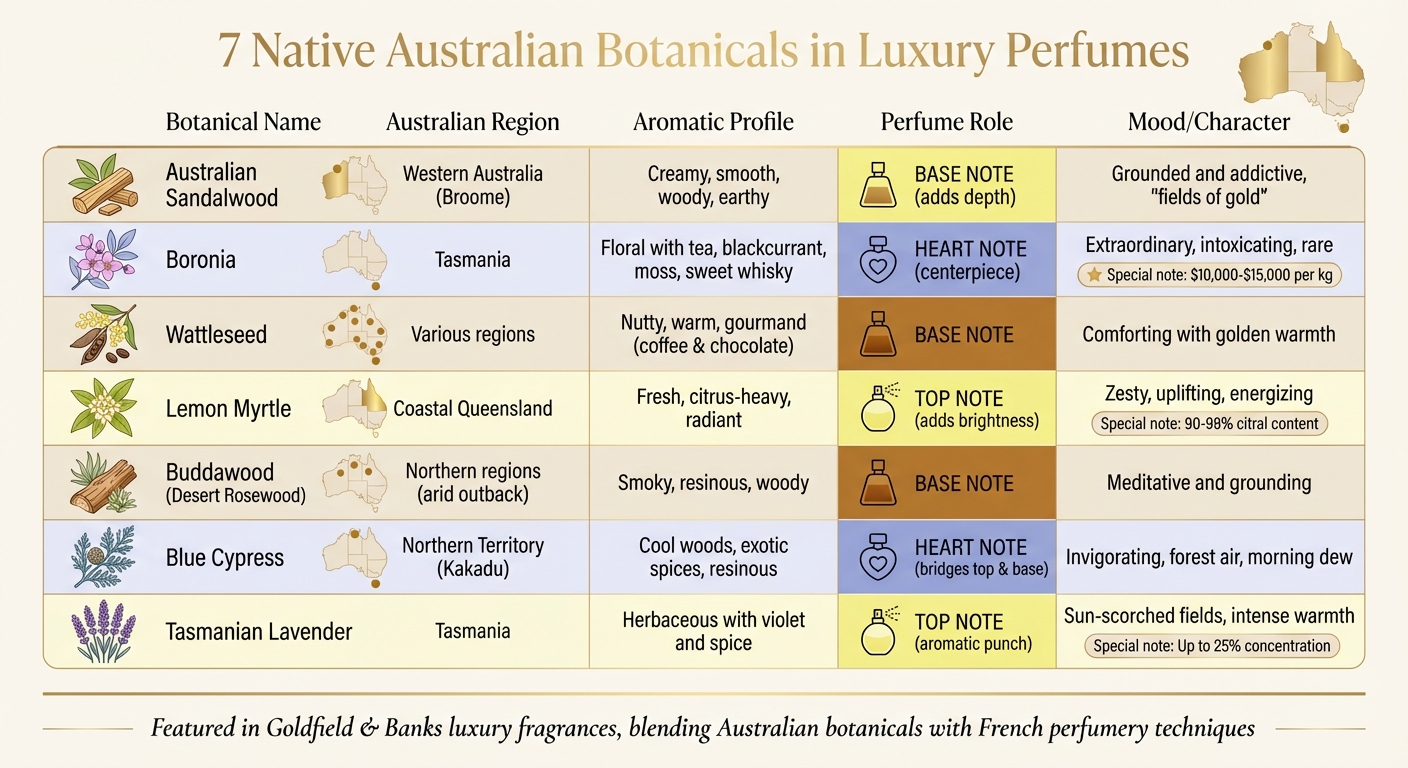
7 Native Australian Botanicals in Luxury Perfumes: Profiles and Fragrance Roles
1. Australian Sandalwood
Aromatic Profile
Australian Sandalwood (Santalum spicatum) is known for its distinct woody and spicy aroma, complemented by soft milky undertones. Unlike the warm, buttery richness of Indian sandalwood, the Australian variety offers a fresher, more refined scent, reminiscent of cedar with subtle creamy nuances. Its top notes bring a warm, spicy complexity with faint floral hints, making it a standout ingredient in fragrance compositions.
Role in Perfume (Top/Heart/Base)
Australian Sandalwood enhances the heart and base notes of fragrances, adding depth and extending their longevity. Its high diffusivity ensures the scent becomes noticeable earlier in the dry-down phase. Remarkably, even a minimal concentration - just 0.1% - can amplify a fragrance's volume and projection, making it a valuable element for creating modern, dynamic scents.
Cultural and Botanical Significance
For thousands of years, Aboriginal communities have valued this tree, known as "Dutjahn", for its ceremonial and medicinal applications. In Australia's arid outback, this resilient species thrives, often flowering when most other plants cannot. However, over 175 years of commercial harvesting have led to a dramatic decline in wild populations - up to 90%. To address this, sustainably managed plantations in Western Australia have become essential. Enterprises like Dutjahn Sandalwood Oils, owned by First Nations groups, are now at the forefront of this sustainable movement . This combination of ancient traditions and modern sustainability highlights its importance in shaping the future of luxury perfumery.
Luxury Perfume Examples
Goldfield & Banks White Sandalwood combines native sandalwood from Kununurra with saffron, thyme, amber, and Turkish rose, creating a spicy, musky fragrance. This perfume has earned a perfect 5/5 rating. Another standout, Goldfield & Banks Silky Woods, features native sandalwood in a creamy, amber dry-down that lasts over eight hours on the skin. It boasts a 4.9/5 rating from 24 reviews.
2. Boronia
Boronia adds a lush, floral complexity to the earthy warmth of Australian Sandalwood, creating a layered and multidimensional depth.
Aromatic Profile
The scent of Boronia (Boronia megastigma) unfolds like a story, starting with fresh floral-green notes that evolve into spicy, woody, and earthy undertones. Packed with beta-ionone and jasmonates, it carries subtle hints of raspberry, apricot, violet, and yellow freesia.
"I can smell tea. And grass. Flowers, of course, but blackcurrant and moss as well" - Dimitri Weber, Founder of Goldfield & Banks
Role in Perfume (Top/Heart/Base)
Boronia typically takes center stage in the heart of a fragrance, bridging the gap between floral, green, and woody elements. Its intense aroma and high cost mean that perfumers use it sparingly, allowing it to create a dynamic scent journey - from an initial floral brightness to richer, spicier, and woodier layers as it dries.
"Boronia is much more complex. The initial impact is floral, but as it dries off you get these spicy, green and woody notes" - Phil Causon, Production Manager at Essential Oils of Tasmania
Cultural and Botanical Significance
Known as the "supermodel" of Australian botanicals, Boronia is as rare as it is exquisite. Its bloom lasts only three to four weeks in September, demanding an intense 14-day harvest period across Tasmanian farms. After harvesting, the flowers undergo a unique 48-hour composting process at 68°F, which doubles their beta-ionone content. With a price tag of $10,000–$15,000 per kilogram and requiring 12.5 million flowers to produce just 2.2 pounds (1 kg) of absolute, Boronia’s scarcity and labor-intensive cultivation highlight its luxury status.
Luxury Perfume Examples
Goldfield & Banks Southern Bloom showcases Tasmanian Boronia Absolute alongside Jasmine Sambac, Cassis, Ylang Ylang, and Sandalwood. Created by Founder Dimitri Weber and perfumer François Merle-Baudoin, this fragrance captures the fleeting beauty of Boronia’s September bloom on Bruny Island. A 100 ml bottle boasts a perfect 5/5 rating from 9 reviews.
3. Wattleseed
Aromatic Profile
Wattleseed brings a roasted, nutty scent to the table, evoking the comforting richness of freshly brewed coffee with subtle hints of chocolate and warm, earthy wood. This unique aroma, derived from native Acacia species, adds a warm and indulgent layer to Australian-inspired fragrances, offering depth and a sense of familiarity.
Role in Perfume (Top/Heart/Base)
In perfumery, Wattleseed shines as a base note, grounding compositions with its coffee-like warmth and woody undertones. It creates a cozy, long-lasting scent that clings to the skin, making it a favorite among perfumers looking to craft fragrances with staying power. This enduring quality reflects Wattleseed's deep connection to Australia's natural and cultural heritage.
Cultural and Botanical Significance
Wattleseed has a rich history intertwined with Indigenous Australian traditions, where it has been used for thousands of years in wellness and healing practices. Today, its allure extends far beyond Australia, captivating European luxury perfumers who value it as an exotic and rare ingredient. Wattleseed's inclusion in high-end fragrances highlights a growing interest in niche materials that tell distinctive stories, resonating with global audiences.
Luxury Perfume Examples
The roasted, nutty essence of Wattleseed finds a perfect home in Goldfield & Banks fragrances, where it enhances the brand’s dedication to showcasing Australian botanicals. Founder Dimitri Weber incorporates this unique ingredient into select creations, celebrating Australia’s aromatic treasures and sharing them with the world in luxurious, memorable compositions.
4. Lemon Myrtle
Aromatic Profile
Lemon Myrtle (Backhousia citriodora) offers a bold and vibrant citrus aroma that even outshines traditional lemon oil. Packed with an impressive citral content of 90–98%, it far exceeds the 2–3% citral typically found in cold-pressed lemon oil. Its scent is a lively mix of zesty citrus, hints of leafy greens, and sweet verbena undertones. This distinct and refreshing profile makes it a perfect choice for an energizing top note in high-end fragrances.
Role in Perfume
Thanks to its bright and invigorating aroma, Lemon Myrtle shines as a top note in luxury perfumes, delivering an instant burst of freshness with the very first spritz. Perfumers often pair it with smooth woody bases or spicy elements to create fragrances that are not only radiant but also beautifully balanced.
Cultural and Botanical Significance
Native to the subtropical rainforests of Queensland, stretching from Cairns to Brisbane, Lemon Myrtle was first documented in 1845 by Ferdinand von Mueller. For First Nations peoples, it has long been cherished for its use in traditional medicine and as a flavorful ingredient in bush tucker cuisine. During World War II, it even stepped in as a lemon substitute for soft drinks when citrus essences were scarce. The establishment of commercial plantations in 1991 has played a key role in preserving wild populations while meeting growing global demand.
Luxury Perfume Examples
Goldfield & Banks Australia incorporates Lemon Myrtle into select fragrances, expertly blending native Australian botanicals with the finesse of French perfumery. The result is a series of transportive compositions that highlight the richness of Australia's aromatic landscape. By focusing on high-concentration Eau de Parfum formulations, the brand celebrates the unique qualities of local ingredients while seamlessly combining them with refined French techniques. This approach not only honors Australia's natural heritage but also brings a touch of authenticity to luxury perfumery.
5. Buddawood
Aromatic Profile
Buddawood, also called Desert Rosewood, carries a deep, earthy, and woody aroma that reflects the rugged beauty of Australia’s dry landscapes. Audrey Denier captured its essence perfectly in Harper's Bazaar:
"A waft of Desert Rosewood instantly conjures the stifling heat of Australia's arid outback, and clothes caked in red dust"
This rich, resinous scent has become a prized ingredient in luxury perfumes, offering a grounding base for sophisticated compositions.
Role in Perfume
Buddawood serves as a strong base note in perfumery, anchoring fragrances with its robust woody character. It often works in harmony with other native Australian botanicals like Sandalwood and Blue Cypress, creating a distinctively Australian fragrance profile. Thanks to its highly concentrated essential oils - developed under the unforgiving conditions of Australia’s arid climate, Buddawood provides exceptional depth and longevity to high-end perfumes. Its versatility allows it to blend seamlessly with other notes, enriching the overall composition and enhancing the storytelling of Australian-inspired scents.
Cultural and Botanical Significance
Thriving in some of the harshest environments on Earth, Buddawood has a rich history that intertwines with both Indigenous traditions and sustainable modern practices. This resilient species, native to Australia, has evolved over 100 million years to endure extreme heat and drought. Indigenous Australians have long valued Buddawood for its role in holistic healing, using it in bush medicine to promote wellness. Today, modern extraction techniques honor these traditions, following ethical and sustainable practices that protect both the environment and cultural legacies.
Luxury Perfume Examples
Goldfield & Banks Australia showcases Buddawood in its fragrance Desert Rosewood, celebrating its resinous and woody characteristics. As founder Dimitri Weber explains:
"Perfumers in the big luxury houses are mesmerised by these exotic ingredients"
This fascination with Buddawood and other native botanicals underscores its growing appeal in the world of luxury perfumery.
sbb-itb-a2a0d05
6. Blue Cypress
Blue Cypress brings a refreshing, forest-like quality to high-end fragrances, drawing inspiration from Australia’s rich natural landscapes.
Aromatic Profile
Blue Cypress carries a cool, resinous woodiness with smoky undertones and a hint of herbal pine. Its aroma is crisp, misty, and slightly zesty, reminiscent of the ancient Kakadu region in Australia. Picture the morning light cutting through the mist, with dew rising from eucalyptus and cypress forests. It’s a scent that captures the essence of clean, invigorating air.
"Blue Cypress is the scent of clean forest air, both invigorating and grounding at the same time." – Lore Perfumery
Role in Perfume
As a heart note, Blue Cypress creates a seamless connection between fresh top notes and earthy base layers. Its concentrated oils ensure the fragrance lasts 8–10 hours, maintaining a crisp, green, and dewy essence throughout. A perfect example of its use is in Goldfield & Banks' Blue Cypress Eau de Parfum, where it’s blended with Bulgarian Lavender, Patchouli, Clove, and Star Anise. This combination offers a modern twist, infused with a distinctly Australian character.
Cultural and Botanical Significance
Blue Cypress, derived from the Callitris intratropica tree, is deeply connected to Australia’s natural heritage. Harvested sustainably from the Kakadu region, it reflects the resilience and unique beauty of the country’s ancient forests. This rare essence embodies the earthy strength and enduring spirit of Australian botanicals.
Luxury Perfume Examples
Goldfield & Banks' Blue Cypress Eau de Parfum is a standout luxury fragrance. Created by Creative Director Dimitri Weber and Perfumer François Merle-Baudoin, it has received a 4.0/5 rating from Lore Perfumery. Reviewers admire its "damp and fresh" quality, highlighting how it transitions to a woodier base while retaining its invigorating charm.
This elegant reinterpretation of a timeless botanical sets the stage for the next captivating essence in our exploration.
7. Tasmanian Lavender
Tasmanian Lavender wraps up our journey with a botanical that takes lavender in a bold, new direction within the world of perfumery.
Aromatic Profile
This lavender variety boasts an aroma that's both intense and layered, blending a gentle sweetness with a crisp, herbaceous freshness. Thanks to Tasmania's rugged climate, it develops a unique depth, offering a sun-kissed dryness with a soft undertone. Its scent reveals a striking violet note paired with spicy, woody nuances, creating a profile that's richer and more sensual than the traditional European lavenders.
"Intensely aromatic, this is a lavender so pure (flourishing in Tasmania's unspoilt landscape) that we swear we feel better simply smelling it." – Suzy Nightingale, Perfume Critic.
Role in Perfume
As a top note, Tasmanian Lavender delivers a powerful aromatic punch before evolving into elegant, layered accords. Its versatility allows it to be used at concentrations as high as 25%, often paired with ingredients like Woodleather, Australian Agarwood, or Patchouli to transition from fresh, clean notes to deeper, more animalic tones.
Botanical and Perfumery Significance
This particular variety of Lavandula angustifolia thrives in Tasmania's pristine environment, yielding oils of extraordinary purity. The challenging climate pushes the plant to develop a potency and antioxidant richness that's hard to match. Grown in a remote, pollution-free setting, it appeals to luxury perfumers who value ingredients with authenticity and traceability. Prestigious brands like Guerlain, LVMH, and Estée Lauder have increasingly turned to Australian botanicals for their distinctive scent profiles and sustainable origins. Tasmanian Lavender embodies the essence of Australian luxury perfumery, offering a refined connection to nature.
Luxury Perfume Examples
In 2024, Goldfield & Banks Australia spotlighted Tasmanian Lavender in their Botanical Series release, with the launch of Purple Suede. Created by Dimitri Weber and perfumer Ilias Ermenidis, this fragrance uses a 25% concentration of botanicals and essences, blending Tasmanian Lavender with Indonesian Patchouli, Civet, and Tropical Australian Agarwood. The 100 mL bottle, is encased in French glass adorned with 24-carat gold. This scent captures the essence of sun-scorched lavender fields, where the purple blooms are imbued with the intense warmth of the Tasmanian sun.
Comparison Table
The table below showcases the origins, scents, roles, and moods of seven Australian botanicals that play a key part in luxury perfumes.
| Botanical Name | Australian Region | Aromatic Profile | Role in Perfume | Mood / Imagery |
|---|---|---|---|---|
| Australian Sandalwood | Western Australia (Broome) | Creamy, smooth, woody, earthy | Base Note (adds depth) | Grounded and addictive, evoking "fields of gold" |
| Boronia | Tasmania | Floral with hints of tea, blackcurrant, moss, and sweet whisky | Heart Note (centerpiece) | Extraordinary, intoxicating, and rare |
| Wattleseed | Various regions | Nutty, warm, gourmand | Heart to Base Note | Comforting with a touch of golden warmth |
| Lemon Myrtle | Coastal regions | Fresh, citrus-heavy, and radiant | Top Note (adds brightness) | Zesty, uplifting, and energizing |
| Buddawood | Northern regions | Smoky, resinous, woody | Base Note | Meditative and grounding |
| Blue Cypress | Northern Territory | Rich woods with exotic spices and resinous nuances | Base Note | Invigorating and grounding, reminiscent of morning dew |
| Tasmanian Lavender | Tasmania | Sunburnt, herbaceous with hints of violet and spice | Top Note (aromatic punch) | Evokes sun-scorched fields and intense warmth |
This table not only breaks down the roles of each botanical but also highlights how their regional characteristics contribute to a well-rounded fragrance composition.
Australian botanicals bring a rugged, earthy charm to luxury perfumes, offering a stark contrast to the classic elegance of French floral notes.
"Australian ingredients are very of the land, they're aromatic and Earthy. Our natives are hardy and organic looking. They're not soft and pretty like the rose and jasmine"
From the creamy warmth of Australian Sandalwood to the rare complexity of Boronia, each ingredient adds a distinct personality. The diversity of these botanicals showcases how Australian perfumery balances bright, fresh top notes with deep, grounding base notes. Lemon Myrtle and Tasmanian Lavender deliver an immediate burst of brightness, while Blue Cypress and Buddawood provide a resinous, woody foundation. Bridging these layers, Boronia offers a rich complexity that evolves beautifully over time.
Conclusion
Australia's unique landscapes: from Tasmania's serene fields to the lush rainforests of Far North Queensland and the breezy shores of the East Coast, are beautifully captured in these seven botanicals. Each ingredient reflects the essence of its origin, turning nature’s diversity into distinctive, evocative scents. What sets this new chapter in perfumery apart is its commitment to both ethical practices and creative innovation.
At the core of this movement lies a dedication to responsible sourcing. Sustainable harvesting methods ensure that rare and precious botanicals, like Agarwood - valued at up to $10,000 per kilogram - are cultivated without harming the environment. By collaborating with local growers, brands not only protect the integrity and future of these resources but also highlight Australia’s expertise in botanical research and development.
Goldfield & Banks has played a leading role in bringing these exceptional ingredients to the global stage. Since its founding in 2016, Dimitri Weber has worked to showcase Australia’s botanical treasures to the world’s top perfumers. As Weber passionately states:
"We have such extraordinary beauty in Australia and incredible botanicals. I love working with perfumers who work with all the prestigious brands and bringing them oils and essences from Australia that they have never heard of."
FAQs
What makes Australian botanicals special in luxury perfumes?
Australia's botanicals hold a special place in luxury perfumery, thanks to their roots in the continent's diverse and untouched ecosystems. These ingredients, often rare on the global stage, are transformed into pure, high-quality oils that encapsulate the raw beauty of Australia's natural landscapes.
The aromatic profiles of these botanicals mirror the vibrancy of the Australian environment. Think zesty citrus bursts, mineral-rich coastal tones, exotic floral bouquets, and rich, earthy wood notes. These fragrances bring a fresh twist to traditional scent collections, offering something distinct for those looking to break away from the ordinary.
Goldfield & Banks has mastered the art of blending sustainability with the sophistication of French perfumery. Their creations celebrate Australia's botanical riches, crafting luxurious fragrances that resonate with perfume lovers around the globe. This thoughtful approach has helped position Australian botanicals as a premium choice in the world of fine fragrances.
How do ethical sourcing practices enhance the quality of these perfumes?
Goldfield & Banks takes great care in sourcing ingredients to create their luxurious perfumes. Every botanical is traced from its origin in Australia's diverse landscape to the finished fragrance. By harvesting ingredients at their prime and avoiding harmful chemicals during processing, the brand ensures the oils retain their natural purity and complexity. This attention to detail is what gives their fragrances their exceptional quality.
The brand also works closely with skilled Australian growers to source rare botanicals in a way that respects the environment. These partnerships not only safeguard natural resources but also enhance the richness and depth of every scent. The result? A collection of cruelty-free, vegan perfumes that capture the true essence of Australia, crafted with unmatched care and dedication.
What makes Australian native botanicals so popular in luxury fragrances?
Australian native botanicals have become a prized element in luxury fragrances, thanks to their distinctive and rare aromatic qualities. These plants, flourishing in Australia's varied landscapes, from arid deserts to coastal cliffs and ancient forests, carry a character that’s hard to replicate. Their natural origins and eco-friendly harvesting practices also resonate strongly with environmentally conscious buyers.
Beyond their fragrance, these botanicals weave a rich narrative of exploration and heritage, drawing from Australia’s remarkable biodiversity. Ingredients like coastal moss or rare agarwood allow perfumers to craft scents that feel both contemporary and deeply connected to the country’s natural splendor. This blend of rarity, exceptional quality, and cultural depth positions Australian botanicals as a standout choice in the world of luxury fragrances.